
Coroplast, Aluminum, or PVC: A Materials Comparison for Weather-Resistant Outdoor Signage
Outdoor sign substrates respond differently to sunlight, moisture, wind, and temperature changes. The right material is therefore the one that can remain readable for the intended display period without adding unnecessary weight or expense.
This question is especially relevant when ordering construction signs NYC, since project information may need to remain visible beside an active job site for months or even years. The New York City Department of Buildings states that applicable construction and demolition sites must display prescribed panels or signs, while the city’s construction rules require certain project information panels to remain in place for as long as the site fence remains.
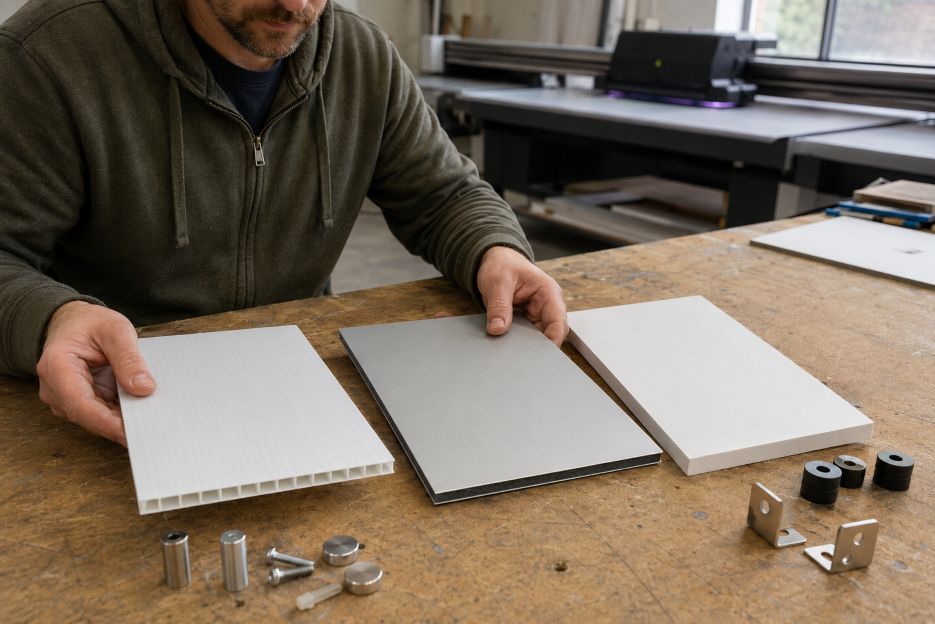
The Case for Coroplast: Practical and Economical
Coroplast is a corrugated polypropylene sheet with hollow channels between two flat outer surfaces. Its low weight makes it easy to carry, cut, mount, and replace. These qualities are useful for directional notices, short construction phases, temporary property signs, event instructions, and other messages with a limited service life.
The material also tolerates moisture because polypropylene does not absorb water like paperboard. However, outdoor exposure still affects it. The manufacturer Coroplast explains that ultraviolet radiation eventually makes plastic brittle and prone to cracking. Its regular white 4-millimeter sheet completed 2,500 hours of accelerated weather testing under SAE J1960 without becoming brittle, an exposure the company relates to approximately one year in Miami conditions.
That result supports coroplast as a reasonable short-term option, but it is not a universal lifespan guarantee. Local sunlight, wind loading, fastening methods, panel size, and physical contact can change performance. The fluted construction is less rigid than a solid panel, so large sheets may bend or crease unless they receive adequate support.
Cost is coroplast’s strongest practical argument. It generally requires less material and is easier to fabricate than heavier rigid boards. Still, the least expensive initial purchase can become less economical when a damaged or faded sign must be printed, transported, and installed again.
The Counterargument: Aluminum Composite for Longer Exposure
Aluminum composite material, often called ACM, consists of thin aluminum skins bonded to a plastic core. 3A Composites describes DIBOND as two pre-painted 0.012-inch aluminum sheets joined to a solid polyethylene core. The company identifies outdoor durability, flatness, and resistance to bowing as key advantages of this construction.
Those properties make ACM attractive for long-running building projects, permanent wayfinding, property identification, and exposed commercial displays. Its smooth, rigid face supports direct digital printing or applied vinyl, while the metal skins help the panel retain a professional appearance after repeated rain and temperature changes.
The tradeoff is higher upfront cost, greater weight, and more demanding fabrication. Cutting, drilling, edge finishing, mounting hardware, and structural support must suit the panel and its location. ACM can therefore be excessive for a notice needed for only a few weekends. For a multiyear installation, however, fewer replacements may justify the additional investment.
PVC: The Middle Position Requires Careful Selection
Expanded PVC offers a smooth, solid printing surface and greater rigidity than corrugated plastic. It can be cut, routed, drilled, and formed into detailed shapes, making it useful when a sign needs dimensional lettering, shaped edges, or a cleaner finished appearance.
Yet “PVC” does not automatically mean outdoor grade. Palram distinguishes general-purpose foam PVC from PALIGHT Outdoor, which is specifically formulated with UV protection for exterior signs and displays. The company also notes that its sign substrates are engineered for ink adhesion and fabrication. Buyers should therefore confirm the exact product grade instead of relying on the material name alone.
Outdoor-rated PVC occupies a useful middle ground. It is usually more substantial than coroplast and easier to shape than ACM. On the other hand, foam boards can expand with heat and may warp when thin sheets are unsupported or exposed to strong temperature differences. Appropriate thickness, mounting clearance, and manufacturer guidance matter.
Ink Performance Is Part of the Material Decision
A weather-resistant board cannot preserve a message if its printed layer fails first. UV-curable inks are commonly used for direct printing on rigid sign substrates because ultraviolet energy cures the ink rapidly on the surface. Even so, print longevity depends on the complete system, including ink formulation, surface preparation, color choice, protective coating, exposure direction, and maintenance.
Material compatibility is equally important. Palram highlights the consistent surface and ink adhesion of its exterior PVC product, while 3A Composites identifies ACM as suitable for digital and screen printing. Coroplast can also be printed directly, but its flutes, surface treatment, and flexibility require the printer to use settings intended for corrugated polypropylene.
A Time-Based Resolution
No single substrate wins every comparison. Coroplast makes sense for brief campaigns, changing site phases, and signs likely to be replaced soon. Outdoor-grade PVC fits medium-term displays requiring a solid face or custom fabrication. ACM is often the stronger candidate when rigidity, flatness, and extended outdoor presentation outweigh the initial price.
The final specification should begin with one question: how long must the message remain safely mounted and easy to read? A realistic service period, combined with site exposure, panel size, print system, mounting method, and replacement access, gives a better answer than price alone. Broader lessons about building safety and preventive maintenance also show why moisture, material deterioration, and routine inspections should be considered around any outdoor installation. For job-site signage in New York or any demanding urban setting, matching the substrate to the project timeline helps keep required information legible without overspending on temporary needs.